

William Negron
As a teenager, William Negron was charged with two separate crimes. He was exonerated for his first conviction due to police misconduct, and later resentenced and released from prison for the second one. He is now devoted to building a productive and meaningful life with his family.
“As far as being locked up for 25 years and getting out … you realize your life is really valuable to you. That you’ve got to make the best of it.” – William Negron
Today, William prides himself on being self-sufficient and in a position to support his loved ones. One of the hardest parts of his incarceration was feeling helpless and dependent on others. “Your parents are struggling [but] you can’t do anything, you’re in prison,” he explains. “That’s the defenselessness that you feel: [there are] things that you want to do, but you can’t.” Following the U.S. Supreme Court ruling in Miller v. Alabama and subsequent decisions at the state level, William was resentenced and ultimately released. He now has the opportunity to give back in the way that he wanted to for so long. “For people who are incarcerated, giving back to society … that’s one of the most important things that a person could do,” he insists.
“Your Number Could Be Up”
William, who is affectionately known as Willie by those closest to him, grew up in the Humboldt Park neighborhood on the west side of Chicago. “It was kind of rough,” he explains. “Our high school back then in the ‘90s was … kind of dangerous at times. There was a lot of gang affiliation going on, shootings here and there, a lot of fights.” Gangs, in particular, were so prevalent that it seemed to him like nearly every young person was affiliated in some capacity. After William himself was caught fighting, he was kicked out of high school and sent by his family to live with his father in Puerto Rico. He enjoyed being there, but found it difficult to suddenly adjust to all aspects of life — and especially high-school-level education — in a second language.
He came back to Chicago and remained closely connected to his circle. “I was always, on my days off, going out and partying and things like that,” he remembers. But for William and his friends, being a bit reckless was more than just teenage antics: there was a pervasive feeling that something bad could happen to anyone, anytime. “Back then, it was, like, you just never know. People were getting killed senselessly,” he says. “You could end up getting killed … so my thing was just: we’re gonna live it as comfortably as possible and make the best of it on our days off, because your number could be up.”
Despite being prepared for tragedy, William did not expect what happened in September of 1994, when at just 17 years old he was charged with two separate crimes within a matter of weeks. William maintains his innocence in both cases, but recalls how the arrest and realization he was being charged with multiple murders felt “like somebody squeezing your heart and just holding it … it felt that painful.”
Incarcerated in pre-trial detention, William felt as though the cards were stacked against him. The whole experience was “such a heavy burden on you already, as it is compared to an adult,” he explains. Throughout his trial, he felt discarded by the criminal legal system. “It feels almost like there was no due process. And it’s like, ‘you’re done,’” William says. He remembers feeling confused and disoriented, constantly asking himself, “Am I going to be able to go home? What age am I going home?”
After being found guilty in his second trial, William was sentenced to life without the possibility of parole, the minimum sentence he could receive with more than one murder conviction due to sentencing laws in Illinois at the time.
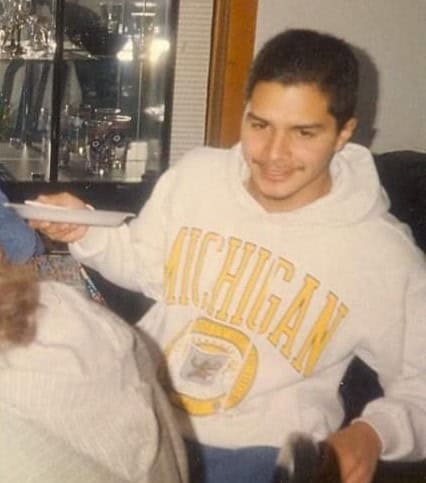
Back then, it was, like, you just never know. People were getting killed senselessly. You could end up getting killed … so my thing was just: we’re gonna live it as comfortably as possible and make the best of it on our days off, because your number could be up.
William Negron
Photo: William as a teen in the early ’90s, before incarceration
The Ripple Effects of Incarceration
As William came to terms with the painful reality of being sentenced to die in prison, he could also see how grueling the experience was for his family. “You can see it in their eyes. … that they feel helpless, and that they’re exhausted, but they can’t no more. They tried so much just to help.” William observes that incarceration harms a number of people beyond just the person in prison. He describes it like a weapon with multiple blades: “you’re stabbing not only me, but you’re also stabbing them, and that’s what the system is doing.”
In particular, William noticed the devastating impact this whole ordeal had on his mother. “Emotionally, mentally, I know it did a really heavy number on her,” he shares. “Because I was the baby, so [my parent’s] baby is, like, gone. And you can’t do anything about it, no matter what you try, and a parent is going to try.”
Indeed, William’s mom was a consistent and reliable part of his support system, but even she felt powerless. “She would visit me a lot,” William says. One day, during one of her prison visits, she told him that she had hit a wall. “She said, ‘I don’t know what to do anymore, Willie, I’ve done everything I could.’ She’s like, ‘Hell, I’ve even written the President of the United States, like, I’ve tried to do everything I could.’ And you could see it in her face, she’s tired.”
After seeing the way his incarceration impacted his family, William wanted to make sure that he could care for himself as much as possible. He explains that while he was in prison, “I was busy working in the laundry and then folding and washing clothes for people … having like a little side hustle. I just didn’t want to put that burden on my parents.” But he also quickly adds that even from a young age, he did all he could to avoid feeling like a burden. “To be honest, even before I got incarcerated, I was like that. I was busy doing a little part-time job with my uncle, and that’s how I got my car. It was a piece of crap, but it was my car.”
Relief through Exoneration and Resentencing
By 2012, when the U.S. Supreme Court ruled that mandatory life without parole sentences for people under 18 was unconstitutional in Miller v. Alabama, William had already been incarcerated for nearly 18 years. He had grown used to being disappointed by the legal system; every one of his appeals and petitions had resulted in the courts upholding the original decisions of his cases. So the Miller decision seemed “too good to be true,” and even then, William knew nothing would happen right away. Miller had to move through another series of court decisions to determine how it might apply to people in each state and whether it would be applied retroactively to those already incarcerated.
Miller moved slowly through the courts, but William was pleasantly surprised by another court ruling: after fighting their convictions in the courts for over two decades, he and a co-defendant had finally been exonerated in one case. The State’s Attorney, faced with significant evidence of police misconduct by Chicago Detective Reynaldo Guevara, requested the convictions be vacated and the case fully dismissed. At least 39 additional convictions have been vacated due to widespread evidence that Guevara coerced witnesses to falsely identify suspects.
As a result of the exoneration, his co-defendant was released from prison and William no longer had the added weight of a second conviction as he prepared to revisit his other, unrelated conviction. Under Miller, William intended to pursue a resentencing hearing for this conviction that would require a judge to consider age-related mitigating factors before determining a sentence.
However, before William even had a chance to bring his case to court, the State offered him a 50-year sentence to be served at 50 percent. This reflected the Illinois sentencing structure from the time of William’s case before the passage of the 1998 Truth-in-Sentencing law. William quickly accepted, despite wanting to pursue actual innocence. “I felt like an auctioneer. ‘Sold!’” he jokes, adding, “I’m not gonna gamble.” Accepting this offer meant that an “out date” was in the foreseeable future, given that he’d served over 23 years at that point. “I was, like, a year and maybe a couple of months from going home,” he points out.
After receiving his new sentence, William was transferred to Dixon Correctional Center — the first medium-security facility of his time incarcerated — to serve out his remaining months. One of the most notable differences he observed was the showers. “When you’re in a [maximum-security facility], you just press the button,” William recalls. “Whatever comes out, that’s it.” By contrast, Dixon’s showers had water pressure and adjustable knobs for temperature. It was William’s first enjoyable shower in decades, and the beginning of a period of tangible hope for something different.
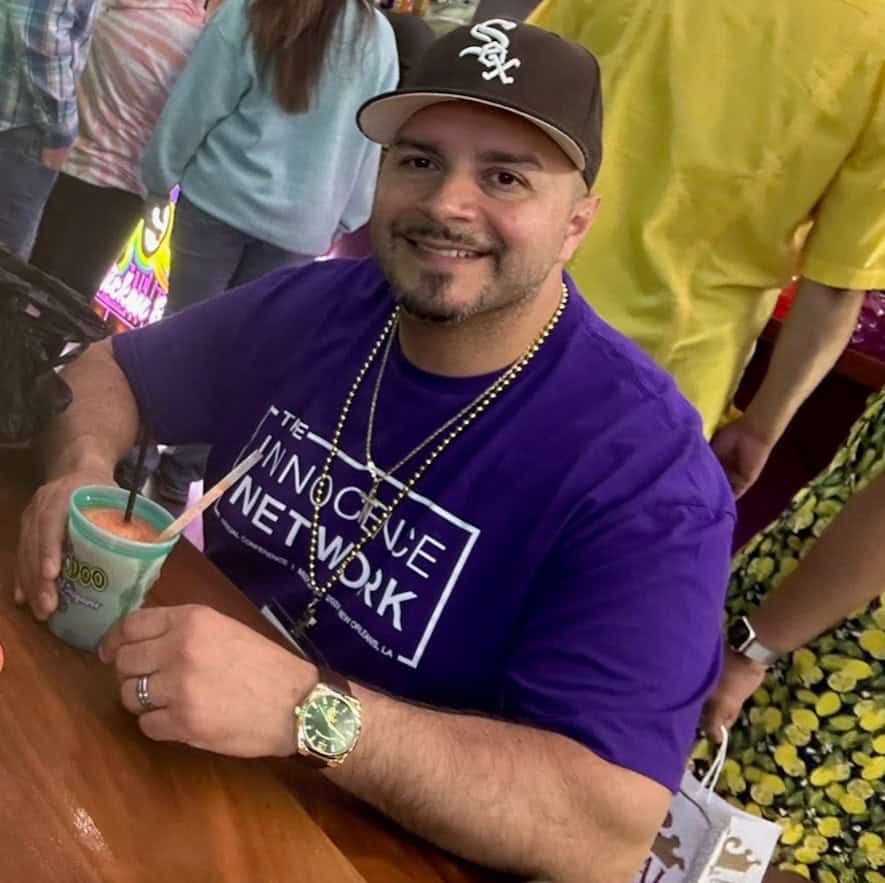
There’s no system in there based on corrections. If ‘corrections’ of ‘Illinois Department of Corrections’ stood for corrections, … the door will be available for you eventually to open.
William Negron
Photo: William in New Orleans at the Innocence Network Conference in March 2024
“Your Future Right Now Starts”
William is now several years into his reentry journey, and by all accounts, he is doing very well for himself: he bought a house, got married, and found a good job. That said, the process has had its challenges. “It wasn’t easy adapting to society,” he says bluntly. “It’s a whole different atmosphere here compared to inside [prison],” he explains. For William, the difficulty is compounded by the amount of time he was incarcerated. “In my strong opinion, the longer you were inside, the bigger chance you have PTSD,” he says. He contends that for some, it can be manageable to live with, while others will need talk therapy or medication. “Everybody has their own way of adapting out here,” he explains.
After lengthy incarceration that began as a teenager, William recognizes that he still has hurdles to overcome. “If you talk to my wife, she’ll tell you, sometimes my mentality is still like a kid’s,” he notes. “Even though some of us [imprisoned as children] are released, our minds stayed that way, they didn’t grow.” Instead of having the opportunity to develop throughout his late teens and twenties, his growth was stunted by prison. “This is what was robbed from us,” he insists.
William regularly advises other returned citizens, who are earlier along in their journeys, on these challenges. For example, he notices how the financial goalposts are constantly moving for many people recently released from prison. It’s hard to ever feel financially secure. “You got your freedom, now you’re stuck on the money. Then what are you gonna do? You’re gonna want more money,” he explains. He tells friends in this situation that “appreciation is key for what you got to do. … You’re free now. Now, there’s no more being in the cell. … You got to be responsible, your future right now starts.”
As William reflects on his own gratitude, he speaks about his close relationship with others: his wife, his children, his parents, his wider family, and a tight-knit group of friends. “I keep my circle small now and stay in contact with a few people,” he explains. In particular, he’s found community with others that have been wrongfully convicted. He focuses his time on “trying to enjoy what we can have in life and seeing other places … just enjoying it.”
He remembers when his dad came into town from Puerto Rico for his wedding. “I took him to the Cubs game,” he says, “and that was the first time I ever went.” He laughs when describing his reaction to some of the unexpected aspects of the game, including $12 beers. “My god,” he jokes, “what they got in there, Moët!? Is that Cristal or something?” But he looks back fondly on going to Wrigley Field, watching the game, and buying jerseys with his dad, an outing that was unimaginable before Miller and before his exoneration.
As William adjusts to life on the outside, he also frequently reflects on the people he left behind. More than a decade after the Miller decision, he sees how “there is hope that this change was a good change, giving people a second chance.” But he is also adamant that “there needs to be more done.” As it is now, the system seems to exist only for punishment. “It feels like more of retaliation,” he stresses. “That’s how it always felt. Because there’s no system in there based on corrections. If ‘corrections’ of ‘Illinois Department of Corrections’ stood for corrections, … the door will be available for you eventually to open.”
William hopes to help others acknowledge that people sentenced as youth, arguably the group most capable of growth, should be given “a reasonable chance” at release. “You want to make sure that taxpayers aren’t going to be picking up the tab again, because you’re letting them out at a very old age,” he explains. “Give this guy an opportunity of a life, to contribute to society.”
More from the “More than a Conviction” Project
Up Next
Read the story of another returning citizen who was sentenced to juvenile life without parole and is now free
Read moreOther stories
Discover the impacts of juvenile life without parole sentences in Illinois from additional perspectives
Learn moreReport
Read the Restore Justice report on juvenile life without parole and extreme sentencing in Illinois
Read the report